PriceOn – Safer Journeys
We were recently subjected to some more propaganda regarding the New Zealand Transport Authority’s ‘Safer Journeys’ and, at the same time, someone couldn’t let the opportunity slip by without adversely commenting on the age of the vehicle fleet, and, of course, opining that the older the car, the more unsafe it is.
The current average age of the vehicle fleet in New Zealand is 13.5 years, and increasing. This is due, in no small part, to me jumping through the various NZTA hoops to put yet more unregistered old motorcycles back on the road.
Around a year ago I wrote on this topic and cited some research I had carried out, which established beyond reasonable doubt that the older the car, the safer it was.
Scare Tactics
Remember the scare tactics around the Warrant of Fitness (WoF) reforms? It went along the lines that changing the WoF requirements would result in more unsafe cars on the road, and therefore, more crashes. Despite this nonsense, the NZTA’s own data suggested that less than two per cent of vehicles involved in crashes had a mechanical defect that contributed to that accident. Thus, 98 per cent of accidents were the result of some other factor other
than age.
As I have previously written, what part of ‘old cars do not cause accidents’ don’t they understand?
In September 2011, the NZTA released its nationwide crash analysis figures for 2006 to 2010. Fifty-one per cent of all injury crashes on Canterbury roads were at intersections. In Christchurch, the figure of intersection injury crashes was 55 per cent. Breaking those figures down a bit further saw motorcyclists involved in 12 per cent, young drivers in 36 per cent, excessive speed was 13 per cent, and alcohol and drugs also contributed to 13 per cent. Funnily enough, the statistics did not mention any old cars being the cause of these crashes.
Crunching the Numbers
NZTA’s own database provides the following irrefutable statistics. Of the number of vehicles each year that are de-registered, have their registrations cancelled, or they just lapse, 80 per cent of them are vehicles less than 10 years old!
Now, vehicle registrations are usually cancelled because the vehicles have been written off in crashes — and those statistics excluded the Christchurch earthquake write-offs. You don’t have to be a rocket scientist to work out that this simply means that cars less than 10 years old are involved in four out of five serious crashes.
Older vehicles had the least number of registration cancellations, which simply means that older cars are involved in the least number of serious crashes and, even then, the registration cancellation was more likely to have been the result of forgetful owners not putting the registration on hold, or the vehicle had passed its ‘best by’ date.
Drivers cause crashes not vehicles.
After a significant amount of study, I have concluded that cars do not run red lights (even that is 80 per cent of less than 10-year-old vehicles), it is the driver that does. It is the driver that ignores red lights, misjudges distances, ignores ‘give way’ signs, ignores speed limits and can’t see cyclists and motorcyclists.
Propaganda
Old cars do not cause crashes. The various Ministers of Transport fall victim to such propaganda, especially when the lobbyists for the new car industry and the importers bombard the government of the day with their fictional, income-related arguments in support of getting older vehicles off the roads.
The Safer Journeys’ only reference that would suggest older vehicles are somehow dangerous is the statement: “We need safer vehicles so that they help prevent crashes and protect road users from crash forces that cause death or serious injury.”
As I’ve said before, what we need is ‘safer drivers’.
So, it would seem that we’re safer in older cars. If less than 10-year-old vehicles make up 80 per cent of write-offs in any one licensing year, that means that, despite all the safety bells and whistles newer vehicles have, they are wasted on their drivers who obviously have little skill behind a steering wheel.
Modern cars see most drivers (over 80 per cent of them) drive beyond their capabilities and limitations, and the NZTA’s crash statistics support this.
So, why push for older cars to be scrapped, when clearly the solution is for us all to drive older cars? As the statistics prove, we will be much safer, and crash statistics will be reduced by as much as 80 per cent.
The Downside
Of course, that won’t happen — and, once again, dollars talk. The more cars sold, the more the Government coffers are recharged with their GST cut. If, as dealers would like us to, we changed our cars every five years instead of nearly every 14, the GST take alone would nearly treble. The downside would be that our balance of payments would upend the scales and our national debt figures would spiral out of control. If we still had an indigenous vehicle manufacturing industry an argument could be made around employment increases, but then hardly anything is ‘made in NZ’ anymore.
So, this month’s homework for the Vintage Car Club (VCC) and the Federation of Motoring Clubs (FOMC) is to lobby Government (and the Minister of Transport) to stop this part of the ‘Safer Journeys’ programme in its tracks.
Supposedly safer cars (and by implication, modern cars) do not on their own reduce crashes. Drivers drive beyond their capabilities simply because the gadgetry in the modern vehicle does everything for them except exercise common sense.
Remember to drive sensibly. The car or motorcycle, however old or new, is not the problem. The only documented vehicle fault ever identified to date that I’m aware of is the tight nut behind the steering wheel!
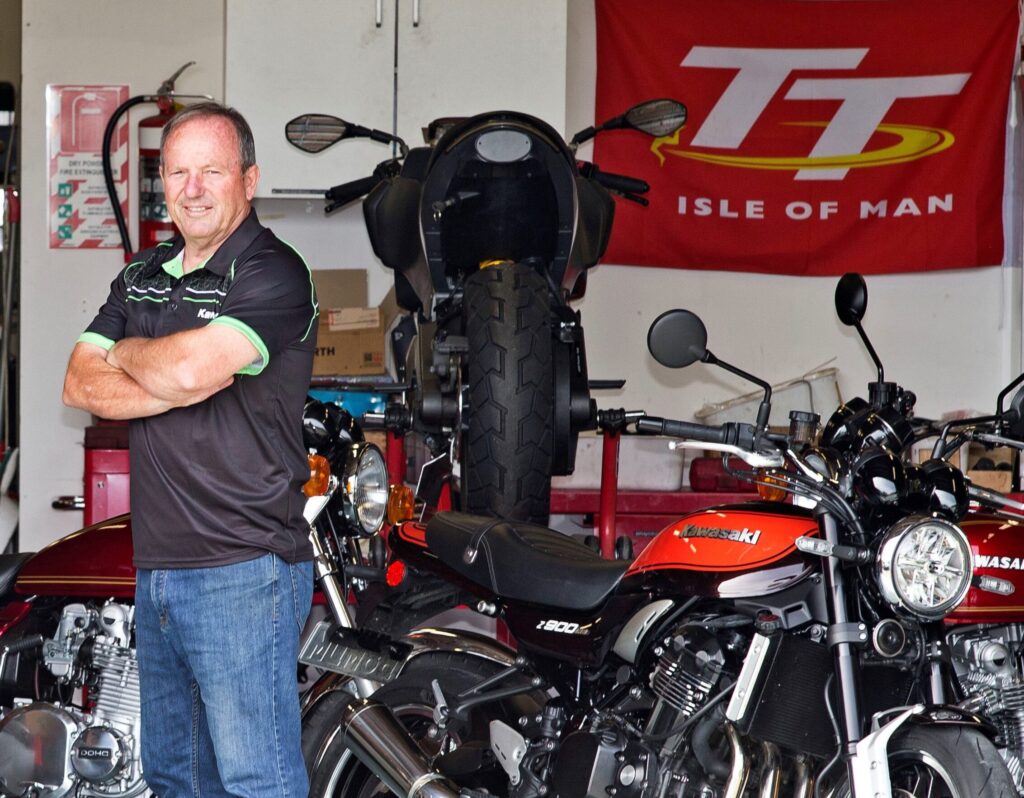
PS: Speaking of driving beyond our capabilities, our vehicle collection now includes a Kawasaki Ninja ZX1100D1, which between 1993 and 1999 was described as the world’s fastest production motorcycle. The speedometer goes up to 320kph! Of course, I will not be doing anything but sticking to the limit, except in closed track conditions. Hopefully nothing will go wrong, but it probably won’t hurt you all to start working on your CVs in case our esteemed editor needs to suddenly find a new columnist! Realistically, however, at the current ACC levy rates I’ll only be able to afford to register it for about one week a year!
This article is from NZ Classic Car issue 270. Get your copy here.
Author: Greg Price Illustration: Steve Richards
Marines at Mahia

Military vehicle enthusiasts – here’s one for your diary:
25–28th October 2013 Marines at Mahia
The New Zealand Military Vehicle Collectors Club is organising an event called The Marines @ Mahia to celebrate the 70th anniversary of when US Marines landed on the beach at Mahia, Hawkes Bay. The Marines carried out their practice landings in their island–hopping campaign across the Pacific to fight the Japanese. There will be a plaque for the US Ambassador to unveil along with military parades, vehicle displays and rides. There will also be an area for US cars to park up on display.
For more information, visit: www.americarna.com/News/Marines-@-Mahia
WIN Superbright Metal Polish
Developed in Hamilton by a master metal polisher/electroplater with 36 years experience, Superbright Metal Polish is an incredibly easy to use, multi-purpose metal finishing polish. Fantastic for all metals – especially chrome, nickel, copper, aluminium and silver – Superbright Metal Polish was formulated and is manufactured in New Zealand for the local metal polishing and electroplating market.
We have 15 250ml bottles of Superbright Metal Polish to give away to our readers. To enter this competition, click here and just answer the following question (hint: visit www.advancedchromeplaters.co.nz):
Q: Name the master polisher behind Superbright Metal Polish.
Competition closes on June 25, 2013
1938 Chevrolet Coupé – The Fabulous Thirties – 270

During the course of any given month, the myriad number of cars that are shuffled in and out of our purpose-built photography studio is nothing short of mind-boggling. Although, in fact, it’s probably not that surprising when you take into consideration that the studio also caters for our sister magazines as well, NZ Performance Car and NZV8. This means the cars up for studio treatment can include anything from superbly restored concours classics to highly modified street machines, wildly custom imports to drift cars, or circuit racers to drag racing machines. At some time or another, examples of all of these types of cars can find themselves posing in our studio.
You might think that for any car enthusiast working in this environment it’s pure heaven, and it is, in a lot of respects. The editorial team has a keen interest in every car and their owners for obvious reasons, but for the rest of the team there’s almost a blasé attitude to all this delectable metal. Our talented designers — by virtue of the fact they work in close proximity to the photography studio — get a first-hand look at every car that rolls in. Some may only be afforded a casual and fleeting glimpse over the top of a computer screen, whilst others may be worthy of closer inspection. Even the administrative and accounting staff might check out what all the fuss is about — or, more likely, find out what on earth is shaking the building.
When Tom Kesha drove this stunning 1938 Chevrolet coupé into the studio there was, indeed, an elevated level of commotion. This gleaming black machine attracted staff members like bees to a honey pot — and that’s not surprising when Read full story…
WIN Build your Own Classic Car

It’s been a while since we featured a classic car model construction set, so this month we’re featuring three new models from AMT’s range of 1:25 scale kits. First up is a model of the infamous ’58 Plymouth Fury that took a starring role in the movie of Stephen King’s Christine. Model–makers can choose to build the car as a standard Fury or, with the aid of the included decals, can customize their model with flames and Christine stickers. Sticking with the movie theme, this 1940 Ford Sedan Delivery connects to the legendary Three Stooges – Larry, Moe and Curly. As with the Christine model, the Ford van can be left standard or customized via a set of colourful decals.
Our final kit is of an Avanti – Studebaker’s swansong and a car that would actually outlive its original manufacturer. This 1:25 kit can be built in one of three guises – either as a standard roadgoing Avanti a customized version or, with the addition of extra parts and decals, as race–car.
Excellent stuff, and any one of these kits will keep an enthusiastic model–maker happy for hours. And, thanks to the local AMT distributors, Toymod, we’ve got one example of the AMT Avanti kit to give away to one lucky reader. :
To enter this competition, click here and answer the following question:
Name the famous designer who penned the unusual lines of the Avanti.
Competition closes on June 25, 2013.
Timelines June 1913, 1938, 1963 & 1988
Once again, Graeme Rice looks back on the motoring worlds of 100, 75, 50 and 25 years ago
June 1913

It may have been August Horch and his team who won the Gold Medal in the 2651 kilometre International Austrian Alpine Rally by just two penalty points in his Type C 14/35hp, but the eyes of the motoring world were on the four avenging Rolls–Royce Continentals of Walter Hives, Jock Sinclair, Curt Cornelius Friese and the man who started all the trouble by stalling on one of the steep Katschberg hairpins, James Radley. The Car magazine described the performance of the Rolls–Royces on the dreaded Katschberg Pass as – “one of the most remarkable displays of automobile efficiency that has ever yet been seen, and one which fairly staggered the spectators who had foregathered at the crucial section of the climb.”
Three Rolls–Royces gained Silver medals, one was awarded a Bronze. C C Friese won the award for a non-stop record.
The first road test of the John Weller–designed four–cylinder AC described the new Ten as being unusually fast for a small car, able to reach a 45mph maximum speed and lap Brooklands at 35mph. Powered by a long stroke (59mm bore/100mm stroke ) four–cylinder, 1096cc French Fivet engine, the 3.3–metre long AC weighed just 475kg. Weight distribution was helped by the three–speed gearbox being integral with the back axle and stopping appeared to be aided by a disc brake protruding from the rear of the differential. Only a small number were built before WW1.
Godfrey and Nash, makers of that superb little cycle–car the GN, finally got their new 1913 GP model into production. This car had a new 90–degree V–twin cylinder engine set across the chassis frame, covered by a conventional bonnet with air scoops on each side, one cooling each cylinder head so they could dispense with an energy-sapping fan. Extra power came from increasing the bore from 80 to 84mm, raising the cubic capacity from 905cc to 1087cc (84 x 98mm). In place of side valves, overhead inlet/side exhaust heads were fitted. Quarter-elliptic springs all round looked after the suspension., and the Grand Prix weighed in at around 400kg.
One enthusiastic GN owner boasted he’d covered 29,000km in 11 months running on a 7 to 1 compression ratio using benzole and a Senspray carburettor. His average fuel consumption was 23.8 kilometres per litre (4.5 litres of fuel per 100 kilometres) or 67 mpg.
Theodore Pilette, the Belgian agent for Mercedes, tried to enter a team of Mercedes for July’s Grand Prix of the ACF to be run at the Amiens circuit but was refused as he was not a manufacturer. He entered five Mercedes for the Grand Prix de France to be run at Le Mans in August instead. These were the last chain-driven cars to race at Grand Prix level. The race was won by Delage, but Pilette finished in third place with another Mercedes in fourth.
June 1938

More GP racing disappointments – the German race at the Eifel meeting was cancelled. Mercedes–Benz were there, but hardly anyone else. The Auto Unions, apart from struggling for competitive drivers, weren’t mechanically sorted and Alfa Romeo decided to stay at home.
Percy Riley’s small luxury car the Autovia was dumped as fallout from the parent company’s receivership continued. In reality it was costing its sponsors money, with just 44 made over two seasons. Designed by Charles van Eugen, the Autovia had proven to be an expensive venture for the ailing Riley company in spite of its attempt to offer Rolls–Royce quality in a smaller car. Michael Sedgwick’s summary was that the Autovia fell between every possible stool. Its 2849cc V8 was quite a powerful motor for its time, developing 72.3kW or 97bhp @ 4300rpm with two Zenith carbs, but it was a weighty beast at around 1800kg. Consensus was the Autovia performed better with the manual gearbox rather than Armstrong Siddeley’s pre-selector with the centrifugal clutch.
Delahaye picked up their first win at the fifteenth Le Mans 24 hour race, with Chaboud and Tremoulet bringing home their Type 135CS six–cylinder ahead of a second Delahaye, with a Talbot coupé in third place. By far the fastest car in the race was a supercharged 3–litre Alfa Romeo 8C 2900B with coupé body by Touring, which had a 12 lap lead after 21 hours racing, before a burst tyre and mechanical problems ended its race. The Delahaye V12 and Talbot 4.5–litre sixes could not match the pace of the Alfa, and retired, leaving the older 3.5–litre Delahaye 135CS to uphold the honour of France, and Bugatti did not bother to enter the ‘tank–bodied’ Type 57 cars which had won in 1937, and would win again in 1939.
Floyd Roberts won at Indianapolis in a Burd Piston Ring Special, entered as a Miller – in fact, powered by a 270ci Offenhauser four. His winning average, from the front row, was a record 117.2mph. Roberts had achieved some notoriety by competing in the 1937 event after breaking his arm racing a motorcycle and managing to dodge the medical. He’d retired after 485 miles.
Four years after it was first envisaged in 1934 the foundation stone for the production of Hitler’s £80 ‘peoples’ car’ was finally laid, although the car itself was not expected to be in production until 1940. Thirty experimental cars had so far covered 1.3 million miles in all conditions, and some had done 62,000 miles.
In order to accommodate workers and their families a new £500,000 town was being built for a population of 60,000 people.
Apparently the German people were in ‘high glee’ at the progress and prepared to begin investing five marks a week into the Labour Front to ensure they would receive their new car. In his speech, Hitler reminded the nation that this car was not intended for those who could afford to buy cars already on offer at their usual prices, but was reserved for those who couldn’t afford the usual car at the usual price. Hitler told the rally that it would not be enough to aim to build two or three hundred thousand of these cars, but six or seven million. Maybe he got something almost right.
June 1963

The sensation of the month was the gas turbine Rover-BRM which Graham Hill and Richie Ginther were driving at Le Mans to see if they could win the £2000 prize put up for the first gas turbine car to circulate for 24 hours at more than 93.3mph (150km/h). “No problem,” said Hill and Ginther after a trouble-free practice session in which they regularly topped 145mph along Mulsanne Straight and put in their fastest lap of 4min 37sec (111.2mph) – a far cry from John Surtees doing a record-breaking lap in 3min 46sec (133.4mph) in a Ferrari.
Practice gave the drivers time to get used to the unusual driving techniques. Things like looking at a rev–counter that read up to 50,000rpm! Waiting 12 seconds for the 150bhp gas turbine to wind up to 40,000rpm before letting off the handbrake to get going. Then once on the move there wasn’t any gear changing, the gear–lever only selected forward and reverse – and there wasn’t a clutch. Braking and accelerating was done in the usual way except there wasn’t any engine braking, so they had to plan new braking points well ahead of the usual spots. Negotiating corners was tricky as drivers had to keep allowing for the delays of several seconds between taking the foot off the brake pedal and beginning winding the turbine up to 40,000 revs to get rapid exits from corners. In some situations this meant they began to accelerate before they entered the corner.
The only concern they had was the time they might spend in the pits getting brake pads replaced and having to pump in 48 gallons (216 litres) of kerosene every 2½ hours.
After 24 hours of racing they finished a theoretical ninth, behind an AC Cobra and a Ferrari GTO, covering 2593 miles at an average of 107.8mph and easily beating the required average by almost 15mph! Otherwise it was all about Ferraris taking the first six places.
Jack Sears was entertaining the British motor racing crowds by throwing his massive Ford Galaxie around the saloon car racing circuits and beating drivers of the calibre of Graham Hill and Roy Salvadori in their Jaguar 3.8s for a third time at Crystal Palace.
The last of a noble breed – the Standard – rolled off the assembly line. The sad fact was that someone had coined the phrase ‘bog standard’ and the marque name now implied a cheap, no frills, rather deprived base model. It was a reflection of changing times that the word Standard no longer meant the highest benchmark, with the best quality built to the point of perfection. Unhappily the last Standard was far from that ideal, just an uninspiring, bog standard, no frills sort of car which Motor’s road testers pointed out was built down to a price, rather than being cheap and nasty in spite of the creaking noises coming from the front seat springs on the car under test. They used phrases like “lack of decoration” “little decoration” and “pleasantly functional” often enough to make the point.
In spite of costing £900 with overdrive, the Ensign struggled to sell even though it was £12 cheaper than the Russian Volga, £36 cheaper than Ford’s Zephyr 6, and £18 cheaper than the Vauxhall Cresta Hydra-matic. Triumph was a much more attractive name for marketing people to deal with.
June 1988

Sir John Egan announced a new super Jaguar, the 220mph XJ220, would be built. This car would eclipse the Ferrari F40 and the Porsche 959, building on the Jaguar XJ-9 Le Mans car’s technology. It would be powered by a mid-mounted 6–litre, V12 motor with 48 valves, have four wheel drive and cost around £120,000. Sir John admitted this was mainly an image building exercise and just 200 would be built.
Tough times for Pininfarina as General Motors cancelled the Cadillac Allante programme two months early as the price had gone up and the sales had gone down. For Farina this was a loss of 41 per cent of their business resulting in a forecast drop in turnover from £150 million to £129 million for the 1988 year alone. GM had originally planned to sell 7000 Allantes a year, but just 3363 had found buyers in 1987 and it looked as thought there were just 2539 orders on hand for 1988. Farina had already reduced production from 30 bodies a day to 12. At £30,000 it was a pricey machine though.
Only the two McLaren drivers, Senna and Prost completed all of the laps in the Detroit US GP to finish first and second respectively, in spite of a brief challenge from Ferrari’s Gerhard Berger. It was Senna’s third consecutive win at Detroit, his record sixth straight pole position, equalling Stirling Moss’s 1959/60 record and Nikki Lauda’s 1974 one.
Organisers were severely criticised for allowing the big TransAm cars to race before the GP, resulting in the track surface being broken up. Only seven of the 26 Formula 1 starters finished. Most had issues with electrics packing up with the constant bumping and thumping. Senna was on 45 points for the world drivers’ championship, Prost on 33 and Thierry Boutsen on a distant 18. McLaren were well clear in the constructors championship sitting on 78 points, 51 points ahead of Ferrari who were on 27.
Enzo Ferrari might have been just a couple of months away from death’s door, but there was fire in the old man’s belly yet. Maybe the lack of victories over the last three seasons were what prompted him to dump his son, Piero Lardi, from having any involvement in the racing side of the business. They had a difference of opinon over Enzo wanting Englishman John Barnard’s trend-setting non-turbo, 3.5–litre V12, fitted with the semi-automatic gearbox competitive as soon as possible, and the turbo cars dumped. Piero was siding with an annoyed Dr Harvey Postlethwaite who had promoted the turbo programme and wanted to see it through to the end of the turbo formula’s life at the end of the season.
After an eventful Le Mans, the Jaguar of Johnny Dumfries, Lammers and Wallace took the chequered flag, denying Porsche an eighth consecutive victory at La Sarthe. The Jaguar covered 394 laps at an average speed of 221.7km/h. With the exception of a Jaguar also taking fourth place, Porsches filled all the remaining slots up to eleventh. At one stage things didn’t look so good for the big cats as, in the first hour Neilsen put his team’s Jag into the sand trap, restarting in 15th place. They fought their way back up to second, only to retire with cylinder head problems. A second Jag retired when it lost its gears at 11pm and was parked up.
Earplugs were standard issues for anyone within earshot of Mazda’s IMSA spec rotary-engined cars with their four rotor 600bhp motors on full song.
In a rare event the organisation at Indianapolis seemed to fall apart. Rick Mears was first, with Emerson Fittipaldi second after being reinstated two hours after the end of the race, and Al Unser was third, all in Roger Penske’s Chevrolet V8-engined cars. For the first time in ten years the Ford DFX-engined cars were knocked off the podium and out of the first three places. Michael Andretti’s March 88C was the highest placed Ford-powered car. In the course of the race where the safety car was out 14 times, and yellow flags were waving here there and everywhere, Emerson Fittipaldi was given a one lap penalty for passing on a yellow flag. This was rescinded but, to the amazement of the team replaced with a two lap penalty which was withdrawn. In addition Fittipaldi’s car had two punctures, was hit by a bird and had to stop to have a nose wing replaced.